Last Updated: June 2026
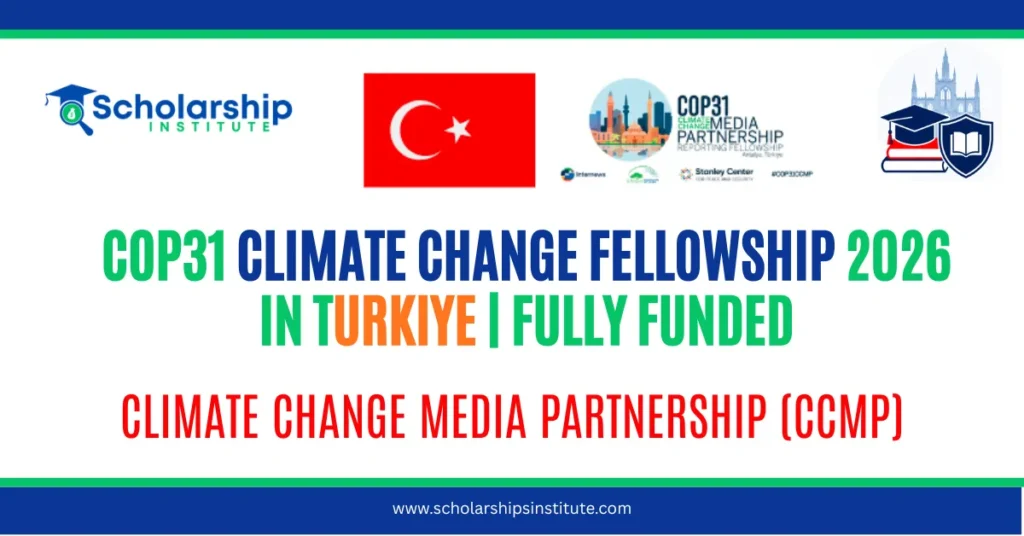
The COP31 Climate Change Fellowship 2026 in Turkiye closed on April 30, 2026, and the official page now says it is no longer receiving submissions. It still matters because the public page shows exactly what this fellowship values: climate-justice thinking, community action, and readiness to work through a full training-to-COP pipeline.
The package is fully funded in the areas the official page names: round-trip airfare, shared accommodation, a meals-and-local-transport stipend, and international health insurance. The one thing the page does not publish is an exact cash amount, so do not copy numbers from blogs unless the official guide confirms them.
What is COP31 Climate Change Fellowship 2026 in Turkiye?
The official program calls this the III Generation of the Fellowship: PATH TOWARD THE DEMOCRATIZATION OF THE FUTURE. Life of Pachamama frames it as a leadership and advocacy fellowship that prepares young people from the Global South to engage in UN climate processes, then return home with a local action plan.
The COP31 Climate Change Fellowship 2026 in Turkiye is not a degree program and not a paid job. It is a fellowship with three stages: virtual training in May–June, international advocacy at COP31 in Antalya from November 9–20, 2026, and a post-COP local-impact phase.
One detail many students miss: the committee does not ask only for good grades. The form asks about your organization, your lived community links, your role in an initiative, and the concrete action you can take after COP. That tells you the program wants movers, not just observers.
What does the COP31 fellowship cover?
| What it covers | What the official page says | What it means in practice |
|---|---|---|
| Airfare | Round-trip airfare from your city of residence to Antalya. | The program handles the travel cost for selected delegates. |
| Accommodation | Shared accommodation during the stay. | You should expect shared lodging, not a private hotel room. |
| Daily support | A stipend for meals and local transportation. | The page does not publish a fixed amount. |
| Insurance | International health insurance. | This is a major plus for international travel. |
| Fees | No registration or participation fees. | You do not pay to enter the fellowship. |
The official page still leaves two things open: the exact stipend amount and the number of awards. I would not publish guesses for either one. The smartest move is to say “not publicly disclosed” until the organization posts a new cycle.
Who is eligible?
| Requirement | Official detail | Pass / fail clue |
|---|---|---|
| Age | Applicants must be 15–30 years old. | Pass if you fit the range on the call date. |
| Program commitment | You must complete all phases and reach 70% training completion to move forward. | Pass if you can stay active through the full cycle. |
| Time commitment | About 15 hours per month is required. | Pass if you can protect steady weekly time. |
| Language | Spanish and English work; basic or intermediate English helps, especially for the international phase. | Pass if you can interact in English at a basic level. |
| Experience | No prior experience in international negotiations is required. | Pass if you are a first-timer with strong motivation. |
| Travel readiness | The form asks whether you can travel to Antalya from November 9–20, 2026. | Pass if your passport, schedule, and visa plan are realistic. |
[IMAGE: eligibility checklist with passport, age, language, and time commitment]
The public page does not list a country restriction. It asks for nationality and country of residence, and it frames the fellowship around the Global South, so I would describe the nationality rule as not explicitly restricted on the public page rather than saying “open to all” without proof.
Required documents and profile signals
The official form asks for far more than a simple name-and-email application. It asks for your nationality, residence, contact details, Instagram, LinkedIn, organization details, bio, experience, motivation, your view of climate change as a political problem, and your post-COP action plan.
Here is how I would prepare each item:
- Bio: Keep it under 250 words and lead with your climate or community work, not your school history.
- Experience example: Pick one concrete initiative and show your role, result, and lesson. The form gives you 300 words, so use them.
- Motivation: Explain why you want to join UNFCCC spaces, not just why you like climate topics.
- Post-COP action: State one local action you can actually run after the summit.
- Logistics: Be ready to answer passport and visa questions honestly.
For minors, the official FAQ says you can apply if you are at least 15 at the time of the call, but selected minors need parental or guardian authorization and any extra legal documentation the organizers require.
How to apply step by step for COP31 Climate Change Fellowship 2026 in Turkiye
Even though this call is now closed, this is the exact flow the official page shows for the April 2026 cycle. The same steps will help you when a new cohort opens.
- Open the official fellowship page:
https://lifeofpachamama.org/en/en-cop31/. That page hosts the application form and the technical guide. - Read the program summary first. The fellowship has three phases, and you need to understand the training-to-COP-to-local-impact path before you answer the form.
- Check your age, passport, and time availability. The page expects ages 15–30, about 15 hours per month, and travel readiness for Antalya.
- Prepare your short bio before opening the form. The form limits this answer to 250 words.
- Pick one strong leadership example. The form gives you 300 words, so write about one project, one role, and one result.
- Draft your motivation answer around climate governance and local action. The form asks why you want to join UNFCCC spaces and what you will do after COP.
- Submit honestly and keep your confirmation email. The page says applicants receive a confirmation after completion, and it tells you to check spam too.
One small but important detail: the official page says the form has 30 questions and takes about 5 minutes. That means the real work happens before you click submit, not during the form itself.
How to write a winning SOP for this fellowship
The committee does not want a generic climate essay. It wants proof that you understand climate change as a political problem, can work with communities, and can turn the fellowship into action after COP. Those ideas come straight from the questions on the official form.
Use this structure:
- Opening: One sentence on the exact problem you want to help solve.
- Middle: One short paragraph on your lived experience or project work.
- Bridge: One paragraph on why COP31 matters to your community.
- Close: One paragraph on the local action you will run after the summit.
A strong opening sounds like this:
“Climate policy fails when the people most affected by it stay outside the room, and I want this fellowship because my community needs a voice in that room.”
That line works better than “I have always been passionate about climate change,” because the official form asks about political understanding, local action, and collective impact.
Keep it tight. For this fellowship, 250–400 words is enough for a short motivation statement, unless the new call gives a different limit. The form itself uses short-answer caps, so long academic paragraphs will hurt you.
Avoid these mistakes:
- writing about climate change in general terms only
- copying a CV into prose
- praising the fellowship without showing fit
- promising impact you cannot actually deliver
If you need a model for application writing, link to your own guidelines content here: https://scholarshipsinstitute.com/guidelines/.
Selection criteria — what they really look for
The form shows the selection logic very clearly. The committee seems to favor applicants who can connect climate justice with community work, explain their role in a real initiative, and stay active through the training phase.
The strongest signals are:
- a real organization, movement, or collective tie
- one concrete leadership example
- a clear post-COP local action
- steady time availability
- enough language ability to participate in the international phase
- a plan to continue community replication after the fellowship
A nuance many applicants miss: previous COP attendance is not required. In fact, the official FAQ says you do not need prior experience in international negotiations. That means the committee likely values potential and readiness, not just past travel.
This is also why a first-time applicant can still compete well. If your local project is specific, your motivation is sharp, and your schedule is realistic, you can outrank someone with more credentials but weaker answers. That is the real lesson hidden in the form.
What applicants from Pakistan, India, Nigeria, and Egypt should check first
Start with your passport. The form asks directly whether you have a valid passport and whether you need a visa, so do not wait until the last week to check travel readiness.
Next, check your English comfort level. The official FAQ says the program works in Spanish and English, and it recommends a basic or intermediate English level for the international phase. That matters if you plan to present yourself as a serious COP participant.
Then check your time. The program expects roughly 15 hours per month, plus assessments and deliverables. If you already have exams, a job, or heavy family duties, be realistic before you apply.
Finally, think about local impact. A strong application from Pakistan, India, Nigeria, or Egypt should not sound imported. It should show how COP31 knowledge will flow back into a real local campaign, campus project, newsroom, or community initiative.
Common mistakes that can sink a good application
The biggest mistake is writing for admiration instead of selection. Do not spend space saying the fellowship is amazing; spend space proving that you fit it.
Another mistake is ignoring the logistics questions. If you cannot travel, need a visa, or lack a passport, the committee will notice quickly because the form asks about all of that directly.
A third mistake is using vague climate language. The form asks how you understand climate change as a political problem, so answer that question directly and in plain language.
FAQ
Does the fellowship have any cost?
No. The official FAQ says the fellowship is fully funded, and it says there are no registration or participation fees. Budget availability still applies, so do not assume every cost is covered unless the call names it.
Do I need prior experience in international negotiations?
No. The official FAQ says prior experience is not required, which makes this a real entry point for first-time climate advocates. You still need a strong local example and a clear reason to join.
In what language is the program developed?
Spanish and English. The official FAQ says a basic or intermediate English level helps, especially for the international phase in Antalya.
How much time should I dedicate to the program?
About 15 hours per month. The official FAQ adds that you also need time for activities, assessments, and deliverables, so do not treat it like a casual side project.
What expenses does the fellowship not cover?
Passport or visa processing fees, personal expenses, and anything the call does not specify. That line matters because many students assume “fully funded” means every single cost disappears.
What if I am a minor?
You may still apply if you are at least 15 at the time of the call. If selected, you need formal parental or guardian authorization and any extra legal documents the program requires.
Conclusion
The COP31 Climate Change Fellowship 2026 in Turkiye is best understood as a climate-justice training and advocacy pathway, not a standard scholarship. The official page shows a clear pattern: it rewards applicants who can think politically, work with communities, and carry the work home after COP31.
The call is closed now, but the next round will likely favor the same things: a strong local story, a realistic action plan, and a calm, specific application. That is the smartest way to approach COP31 Climate Change Fellowship 2026 in Turkiye when a new cycle opens.