
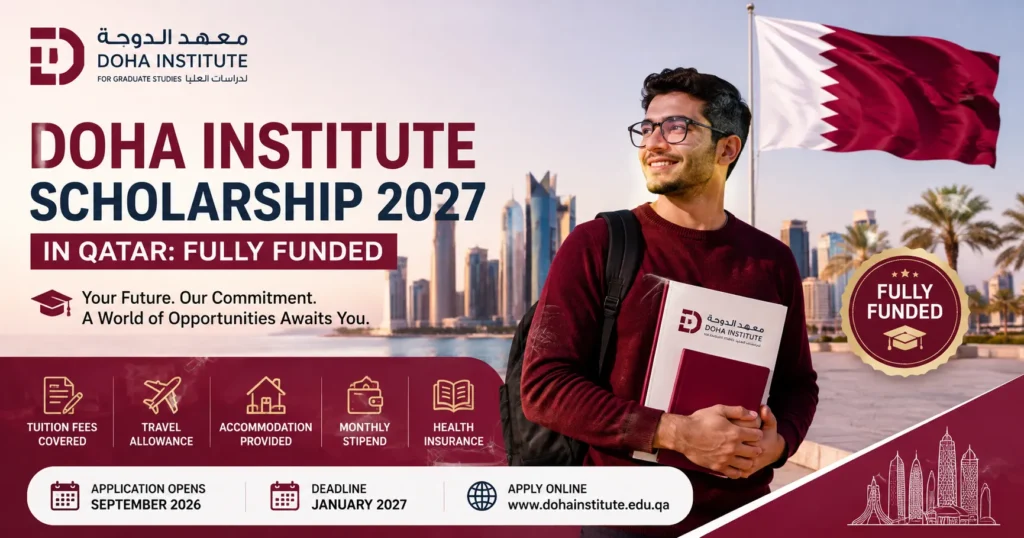
The Doha Institute’s published scholarship policy gives eligible international students 100% tuition coverage, institute housing, a monthly allowance, health insurance and two international flight tickets. More importantly, the Institute’s admissions workflow does not simply rank applicants by GPA: candidates move through transcript screening, academic evaluation and an interview, with the final ranking split 50% academic evaluation and 50% interview.
If you’ve studied the Doha Institute Scholarship 2027 in Qatar application process before, you already know where many applicants go wrong: they treat the scholarship as a simple funding form instead of first building a strong graduate admission application. The Institute evaluates academic records, program fit and interview performance, so your preparation needs to cover all three.
What is the Doha Institute Scholarship 2027 in Qatar?
The Doha Institute for Graduate Studies offers graduate scholarships to attract academically qualified students from Qatar and abroad. Its published scholarship policy divides institutional funding into merit-based Tamim Scholarships and need-based Sanad Scholarships.
The Institute focuses on graduate education in areas such as social sciences, humanities, public administration, development economics, public policy, conflict and humanitarian studies, security studies, media, human rights and related disciplines. Its official admissions office describes the institution’s goal as attracting strong students and assessing their potential for academic success and program fit.
For 2027 applicants, the key point is simple: admission and scholarship consideration are connected, but you should not treat them as the same step. The published Sanad policy says students apply for the need-based scholarship after admission, while Tamim awards rely on academic merit assessed during the admission process.
Quick facts
| Detail | Information |
| Institution | Doha Institute for Graduate Studies |
| Country | Qatar |
| Main levels | Master’s and PhD |
| Scholarship tracks | Tamim and Sanad |
| Main basis | Merit or financial need |
| International eligibility | Available under the published international-student rules |
| Tuition | Up to 100% for eligible international recipients |
| Housing | Institute accommodation covered for eligible international recipients |
| Monthly allowance | Provided; exact amount not officially specified |
| Flights | Outbound at program start + return at graduation under published policy |
| Health insurance | Covered where the policy conditions apply |
| 2027 deadline | January 15, 2027 is widely reported; verify in the official portal |
The official scholarship page exists, but its current web version does not expose the scholarship text in a crawlable format. For that reason, use the official policy documents and Admissions Office pages as the primary verification sources.
What does the Doha Institute Scholarship cover?
The published official policy provides much more useful detail than many third-party pages. For eligible international recipients, both the Tamim and Sanad policies can provide full tuition and institute housing, plus a monthly allowance, international travel and health insurance under the stated conditions.
| Funding item | What the official policy says | What it does not specify |
| Tuition | 100% for eligible international recipients | Exact monetary value depends on program fees |
| Institute housing | 100% housing-fee coverage | Personal housing preferences are not listed as cash alternatives |
| Monthly allowance | Monthly allocation provided | Exact QAR amount not officially stated |
| Airfare | One ticket from home country at program start and one return ticket at graduation | Personal or extra travel is not listed |
| Health insurance | Covered for qualifying students without other insurance | Exact private-insurance cash value not stated |
| Cash replacement | Not offered for unused listed benefits | Students cannot demand cash for benefits they do not use |
That last point matters. The official policy specifically says scholarship recipients cannot convert unused benefits into cash.
Tamim Scholarship
The Tamim Scholarship rewards academic merit. The published policy says the Institute’s Admissions and Scholarships Committee allocates Tamim awards based on the student’s academic merit as assessed during admission.
For international students, the published policy provides:
- 100% tuition coverage.
- 100% institute housing fees.
- A monthly allowance determined by the Institute.
- One flight from the home country at the beginning of the program.
- One return flight at graduation.
- Health insurance when the stated insurance condition applies.
Important: I would not publish a “$2,500 monthly stipend” figure as an official Doha Institute amount. Current scholarship websites quote different figures, but the official policy I could verify only says that the Institute determines the monthly allocation.
Sanad Scholarship
The Sanad Scholarship uses financial need as its main basis. The official policy says international students can receive 100% tuition coverage, institute housing and the other listed benefits, while Qatari and Qatar-resident applicants may receive partial or full tuition support according to need.
This creates an important distinction:
Do not write your Sanad application as though financial hardship alone guarantees an award. You still need admission first, and the Institute considers the student’s financial need within its scholarship process.
Who is eligible?
The Doha Institute Scholarship 2027 in Qatar eligibility requirements depend on whether you’re applying for a Master’s or PhD and which scholarship rules apply. The Institute’s graduate programs also set their own admission conditions, so meeting the general scholarship rules does not guarantee admission.
Eligibility table
| Requirement | Detail | Pass/Fail indicator |
| Nationality | International students can apply under the published scholarship rules; Qatari and Qatar-resident applicants also have defined routes | ✅ If your program accepts your applicant category |
| Degree | Master’s applicants need a Bachelor’s degree or qualifying final-year status; PhD applicants need Bachelor’s + Master’s qualifications | ✅ If academic qualifications match |
| Academic record | Strong academic performance matters because DI uses competitive evaluation | ✅ If your record is competitive |
| English | Master’s programs have specific IELTS/TOEFL/Duolingo thresholds; PhD requires IELTS 6.5 or equivalent | ✅ If you meet your program’s requirement |
| Program fit | Your previous education and intended field must support the chosen program | ✅ If the program accepts your background |
| Other scholarship | Institute scholarships generally cannot be combined with another scholarship without the required approval | ❌ if you plan to double-fund without approval |
| Previous DI scholarship | Previous recipients of the same Institute scholarships may face restrictions | ❌ if the relevant restriction applies |
| Executive Master’s | Institute scholarships do not cover Executive Master’s programs under the published scholarship policy | ❌ for the Institute scholarship |
| Diploma/specialized certificate | Excluded from Institute scholarship funding under the published policy | ❌ |
The official scholarship policy explicitly excludes Executive Master’s, diploma and specialized certificate students from Institute scholarships.
Master’s eligibility
For standard Master’s programs, the Institute publishes English admission thresholds. The current official language document lists IELTS Academic 5.5 as the admission requirement, alongside TOEFL iBT 59 and Duolingo 95. Applicants can receive an English-language waiver if they completed a Bachelor’s degree at an eligible English-medium university and provide the required official proof.
The 5.5 IELTS figure needs careful interpretation. It represents an admission requirement, not a promise that a 5.5 applicant will win a scholarship. The Institute’s competitive academic evaluation comes after the initial screening stage.
PhD eligibility
PhD applicants face a more demanding academic profile. The official doctoral admission policy requires a Bachelor’s degree in the specialization or a related field with at least 3.2/4.0, plus a Master’s degree or equivalent with at least 3.5/4.0. The research field should relate to the candidate’s academic specialization.
The doctoral policy also requires IELTS 6.5 or equivalent, although the Institute can waive the English requirement for graduates of endorsed universities where English served as the official language of instruction.
PhD applicants should also prepare a 750–1,000-word statement of interest, a 2,000-word dissertation proposal, a CV, academic records, a research sample or Master’s thesis and three academic recommendation letters.
What documents do you need?
The Doha Institute scholarship required documents depend on your program. Don’t use a random checklist from another scholarship website. Match every file against your chosen Master’s or PhD program.
For standard graduate admission, prepare the following core documents:
- Passport or official identification
International applicants should prepare a clear passport copy. Check that the document remains valid and that the personal information matches your application exactly. - Bachelor’s degree or proof of expected graduation
Final-year students should follow the Institute’s instructions for submitting proof of expected completion. - Academic transcripts
Upload complete records rather than only your final-year transcript. Your transcript plays an important role in the first screening stage. - English-language test result
Use the test and minimum score accepted by your program. The standard Master’s document lists IELTS, TOEFL and Duolingo pathways. - Curriculum vitae
Keep your CV focused on evidence that supports your graduate-study goals: research, internships, publications, relevant work, projects, leadership and academic activities. - Personal statement or statement of interest
Connect your academic background to the program you selected. Don’t turn it into a life story. - Academic essay or writing sample where required
This matters especially for programs that use writing to judge analytical ability. - Recommendation letters
Follow the number and submission method specified by your program. Doctoral applicants need three academic recommendations under the official doctoral policy. - Research proposal for PhD applicants
The official doctoral policy requires a 2,000-word dissertation proposal. - Master’s thesis, capstone or research sample for PhD applicants
The Institute asks doctoral candidates to provide evidence of previous research ability.
Three document mistakes to avoid
First: don’t upload blurry scans. A strong academic record becomes useless if the admissions team cannot read your transcript.
Second: don’t submit a generic personal statement to every university. The Institute evaluates applicants within individual academic programs, so your statement should explain why that particular program fits your academic direction.
Third: don’t wait for the application deadline to request recommendations. A professor who needs two weeks to write a serious letter can become the reason you miss a January deadline.
How to apply step by step
If you’re asking how to apply for Doha Institute Scholarship 2027, follow the process in this order.
Step 1: Choose one realistic program
Start with the academic program, not the scholarship. Review the program’s field, language, entry requirements and research direction.
Step 2: Check the academic requirements
Compare your degree, grades, language score and background with the official program requirements. PhD applicants should pay particular attention to the 3.2 Bachelor’s and 3.5 Master’s GPA requirements in the doctoral policy.
Step 3: Prepare your academic evidence
Collect transcripts, certificates, passport documents, language results, CV materials and recommendation contacts.
Step 4: Build your statement around program fit
Identify the academic question or professional problem that connects your past experience to the graduate program. Then explain why DI provides the right environment for your next step.
Step 5: Submit the admission application
Use the official Doha Institute Admissions Office application system.
Step 6: Check every uploaded document
Before submission, open every PDF yourself. Confirm that names, dates, grades and document translations match.
Step 7: Submit before the published deadline
Current 2027 scholarship listings report January 15, 2027 as the deadline. Because the official 2027 scholarship page does not currently expose the date in crawlable text, verify the deadline inside the official application system when the cycle opens.
Step 8: Prepare for transcript screening
The Institute’s official selection workflow says applicants need a transcript evaluation score of at least 7/10 to move forward.
Step 9: Prepare for academic evaluation
The Institute sends qualifying applications to academic evaluators. Three evaluators assess applications within the program, and applicants need a cumulative academic evaluation score of at least 6/10 to progress.
Step 10: Prepare for the interview
Applicants who pass the academic evaluation move to the interview stage. The Institute’s published workflow says the final ranking uses 50% academic evaluation and 50% interview evaluation.
Step 11: Complete the scholarship stage
For Sanad, the published policy says students apply after admission and provide the information required for the financial-need assessment. Tamim awards depend on academic merit assessed during admission.
Step 12: Follow the scholarship conditions
Do not assume the award lasts regardless of academic performance. The official policy says students must maintain the academic conditions attached to their scholarship.
How to write a winning SOP for the Doha Institute
Your statement should answer one question:
Why does this specific graduate program make sense for your academic and professional direction?
Don’t begin with:
“Since childhood, I have always dreamed of changing my country.”
That sentence tells the committee almost nothing.
Instead, open with a specific problem you have studied, experienced through work, researched academically or want to investigate.
A stronger opening model
“During my undergraduate research on local public-service delivery, I found that the problem was not simply a lack of resources; it was the absence of reliable evidence connecting policy design with implementation.”
That opening creates an academic problem. You can then connect it to your degree, research interest and career goal.
A practical SOP structure
Paragraph 1 — The problem:
What issue motivates your graduate study?
Paragraph 2 — Your preparation:
What did your degree, research, work or community experience teach you about that issue?
Paragraph 3 — Why this program:
Name the academic skills, methods, courses or research environment you need.
Paragraph 4 — Why DI:
Explain why the Institute fits your academic direction rather than simply saying “Qatar is a great country.”
Paragraph 5 — Future impact:
Show what you plan to do with the knowledge after graduation.
What should you avoid?
- Empty claims about leadership.
- Ranking the university without connecting the ranking to your goal.
- Repeating your CV.
- Overusing emotional hardship.
- Making political claims you cannot support.
- Writing a statement that could fit ten other universities.
- Claiming a research interest you cannot explain during an interview.
Word count guidance
For Master’s applicants, follow the exact word limit and statement format shown in the current application portal or program instructions. For doctoral applicants, the official policy gives a clear 750–1,000 words for the statement of interest and 2,000 words for the dissertation proposal.
What the committee’s process tells you
The Institute’s selection system gives a major clue: your written application feeds into the academic evaluation, but your final result also depends on the interview. That means your SOP should describe ideas you can defend verbally.
If your statement says you want to research development economics but you cannot explain your research question during the interview, the written application won’t save you.
Selection criteria — what they really look for
The Institute publishes more information about selection than many scholarship websites acknowledge.
Its process works like this:
Transcript evaluation → academic evaluation → interview → final ranking.
The first filter requires a transcript score of 7/10 or higher. Applicants then undergo academic evaluation, where three evaluators assess the application for the program. A cumulative academic evaluation score of 6/10 or higher moves the applicant to the interview stage. The final score combines academic evaluation and interview performance equally.
Insight 1: GPA gets you through the door, but it doesn’t finish the job
A high GPA helps at transcript screening. It doesn’t replace program fit, academic writing or interview preparation.
Insight 2: The interview has real weight
The official workflow assigns 50% of the final evaluation to the interview. That’s significant. Prepare to explain your academic interests, previous work, research direction and reasons for choosing the program.
Insight 3: Your application needs internal consistency
Your transcript, CV, statement, academic essay and interview answers should tell the same story.
For example, if your CV shows economics research, your statement discusses development policy and your interview focuses on labor-market reform, the committee can see a coherent direction.
Insight 4: PhD applicants face a different standard
Doctoral applicants need a stronger research foundation. The official policy asks for a research sample or Master’s thesis, a 2,000-word proposal and three academic recommendations.
Insight 5: Scholarship funding has conditions
Full doctoral scholarship recipients must contribute at least 10 hours per week to Institute research, teaching or other required work during the semester. Partial recipients have proportional obligations capped at 15 hours per week.
That is an important difference from scholarships that simply provide funding with no institutional service requirement.
The mistake students make about “fully funded”
“Fully funded” doesn’t mean “every possible expense becomes cash.”
The official policy provides a defined package. It covers tuition and housing for eligible international recipients, provides a monthly allowance, and includes specified travel and insurance benefits. It also says students cannot exchange unused benefits for cash.
The exact monthly stipend amount is not officially specified in the publicly accessible policy I could verify. Several third-party websites publish dollar figures, but I would not treat those numbers as official unless the Institute confirms them for the 2027 cycle.
That’s especially important for students budgeting from Pakistan, India, Nigeria, Egypt or other countries where currency conversion can change the real value of a stipend.
Advice for applicants from Pakistan, India, Nigeria and Egypt
Your nationality doesn’t replace academic competitiveness. Focus on the evidence that the admissions committee can evaluate.
Pakistan
Don’t rely only on percentage-to-GPA conversions from random websites. Submit the official transcript and let the Institute assess your academic record according to its own process.
India
A strong CGPA helps, but your statement should explain what you want to study beyond your undergraduate coursework. A clear research question can distinguish you from applicants who only describe career ambitions.
Nigeria
If your professional experience supports your intended program, use measurable examples. Instead of writing “I led a community project,” explain what you changed, who benefited and what evidence shows the result.
Egypt
For applicants with Arabic-language academic backgrounds, make your language preparation clear. Don’t assume the committee will infer your proficiency from your previous education.
UAE and Gulf residents
Being a resident in Qatar or another Gulf state doesn’t automatically mean you receive the same scholarship treatment as an international student abroad. Check the applicant category and current scholarship rules before budgeting around full international benefits.
Master’s vs PhD: which route fits you?
| Feature | Master’s | PhD |
| Previous degree | Bachelor’s | Bachelor’s + Master’s |
| Academic threshold | Program-specific | Bachelor’s 3.2 + Master’s 3.5 under doctoral policy |
| English | Standard Master’s threshold varies by accepted test | IELTS 6.5 or equivalent |
| Research proposal | Program-dependent | 2,000-word dissertation proposal |
| Statement | Program/application requirement | 750–1,000 words |
| Recommendations | Program-specific | Three academic recommendations |
| Research sample | May be required by program | Required in doctoral policy |
| Scholarship structure | Tamim/Sanad institutional rules | Separate three-phase doctoral policy |
| Service requirement | Depends on award/program | Full scholarship: at least 10 hours/week |
The PhD route demands more research preparation and carries a distinct scholarship structure. The official doctoral policy divides scholarship support across coursework, prospectus and dissertation phases.
Doha Institute vs other funded Qatar options
If you’re comparing fully funded scholarships in Qatar, don’t stop with one application.
Qatar University Bachelors Scholarships 2026 in Qatar can suit students seeking undergraduate study, while Hamad Bin Khalifa University Scholarship 2026 provides another graduate-level Qatar option.
For students considering funded Master’s programs outside Qatar, Chevening Scholarship 2027 provides a useful comparison because it uses a different selection model and career-focused application strategy.
The smart approach isn’t to decide which scholarship sounds best. Match the scholarship’s selection system to your profile.
FAQ
Is the Doha Institute Scholarship fully funded?
Yes, eligible international recipients can receive full tuition and housing plus a monthly allowance, specified travel benefits and health insurance under the published scholarship policy. The exact monthly allowance amount does not appear in the publicly accessible official policy.
Is the Doha Institute Scholarship open to international students?
Yes, the published scholarship policy includes international students, as well as Qatari and Qatar-resident applicants under defined rules. International applicants should still check the current program and scholarship conditions before applying.
Can Pakistani students apply for the Doha Institute Scholarship?
Yes, Pakistani applicants can apply as international students if they meet the admission and scholarship requirements of their chosen program. Your nationality does not remove the need to pass the Institute’s academic screening and interview stages.
Can Indian students apply for the Doha Institute Scholarship?
Yes, Indian students can apply as international applicants if they satisfy the relevant program requirements. Prepare your transcripts, language evidence, statement and other documents before the application window closes.
Can Nigerian students apply for the Doha Institute Scholarship?
Yes, Nigerian students can apply as international applicants under the Institute’s graduate admissions and scholarship rules. Your application still needs to compete successfully through transcript, academic and interview evaluation.
What IELTS score does the Doha Institute require?
Standard Master’s programs currently list IELTS Academic 5.5 as an admission threshold, while the official doctoral policy lists IELTS 6.5 or equivalent. Some applicants can qualify for an English-language waiver under the Institute’s rules.
Does the Doha Institute Scholarship cover accommodation?
Yes, the published policy provides 100% coverage of institute housing fees for eligible international recipients. The policy also says students cannot request cash instead of unused scholarship benefits.
How much is the Doha Institute monthly stipend?
The official policy confirms a monthly allowance but does not publish the exact amount. Students should avoid relying on unofficial dollar figures until the Institute confirms the amount for their cycle.
Is the scholarship application separate from admission?
For Sanad, yes: the published policy says students apply for the need-based scholarship after admission. Tamim awards use academic merit assessed during the admission process.
What is the PhD scholarship work requirement?
Full doctoral scholarship recipients must work for the Institute for at least 10 hours per week during the semester in research, teaching or other required areas. Partial scholarship recipients have proportional requirements capped at 15 hours weekly.
Final checklist before submission
- Choose the correct Master’s or PhD program.
- Check the current official admission requirements.
- Confirm your degree and transcript eligibility.
- Check your IELTS, TOEFL or Duolingo score.
- Prepare certified or official academic documents where required.
- Request recommendation letters early.
- Write a program-specific personal statement.
- Prepare the academic essay or writing sample if your program requires one.
- PhD applicants should prepare the 2,000-word research proposal.
- Submit the admission application through the official portal.
- Recheck every uploaded document.
- Prepare for the academic evaluation.
- Prepare seriously for the interview.
- Complete the scholarship stage when instructed.
- Verify the 2027 deadline directly in the official portal before submission.
Conclusion
The Doha Institute Scholarship 2027 in Qatar stands out because its published international scholarship package goes beyond tuition: it can include institute housing, a monthly allowance, health insurance and defined international travel support.
But don’t make the common mistake of treating this as a simple “fully funded” form. The Institute’s selection system filters applicants through transcript evaluation, academic assessment and an interview, with the final result split evenly between academic and interview performance.
If you want a serious chance, build the application backward from the selection process: strengthen your academic evidence, make your statement specific to the program, prepare a research direction you can defend, and rehearse the interview before you submit. The 2027 deadline currently reported across scholarship listings is January 15, 2027, but verify the live date on the official Doha Institute portal when the cycle opens.
Official application and verification: Doha Institute Admissions Office