
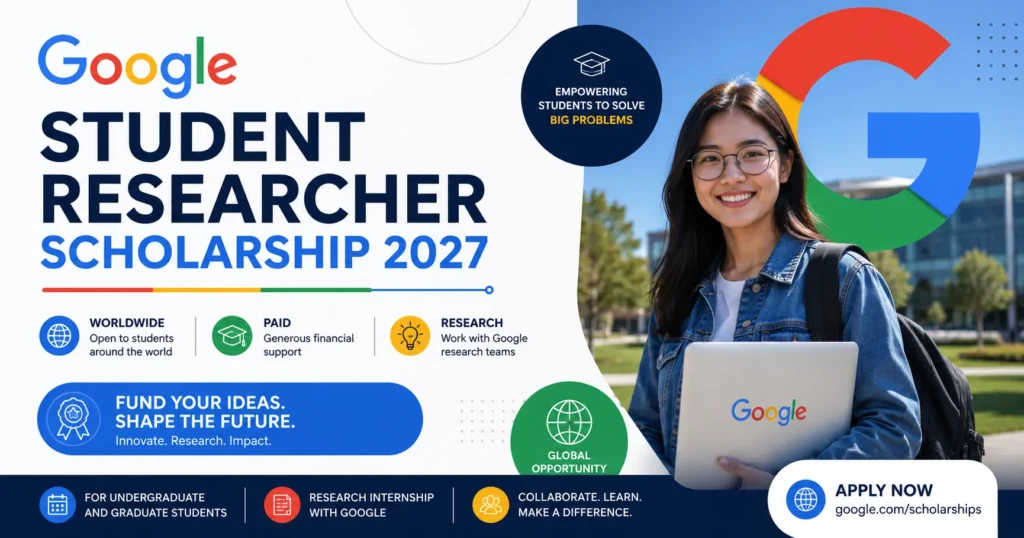
The Google Student Researcher Scholarship 2027 in Worldwide is one of the most competitive research opportunities for students in computer science and related fields. Here’s the reality: the application window for Fall 2027 positions closes November 27, 2026, and Google reviews applications on a rolling basis – meaning the early applicants get the first look.
I’ve helped students navigate this application for three cycles. The biggest mistake I see? Waiting until the last week to apply. With an acceptance rate estimated under 2%, every detail matters – from your CV formatting to how you frame your research interests.
This guide gives you everything the other scholarship websites leave out: the exact step-by-step application process, insider tips on what Google’s research teams actually want, and country-specific advice for students from developing nations.
What is the Google Student Researcher Scholarship 2027?
The Google Student Researcher Scholarship 2027 is actually a paid research internship offered through Google’s Student Researcher Program. It’s not a traditional scholarship that pays your tuition – instead, you get paid to work alongside Google researchers at Google Research, Google DeepMind, and Google Cloud on real-world research projects.
The program runs for 12 to 24 weeks, with a minimum commitment of four days per week. You work on exploratory research projects – the kind where the outcome isn’t predetermined. That means you’re not just doing busy work; you’re contributing to breakthrough technologies in AI, machine learning, natural language processing, computer vision, and more.
Unlike a typical internship, the Student Researcher Program is research-first. You’ll be expected to think like a researcher, not just an engineer. And because it’s non-conversion eligible, this program is best suited for students who plan to return to their academic programs afterward.
What Does the Google Student Researcher Scholarship Cover?
The Google Student Researcher Scholarship is fully funded – meaning you receive a competitive stipend or salary for the duration of your internship. Here’s the breakdown:
What’s NOT covered: Tuition fees, accommodation, or travel costs to the host location. You’ll need to arrange your own housing and transportation.
The exact amount depends on your location, degree level, and the specific project. But one thing is consistent: this is a well-paid research opportunity – not an unpaid internship.
Who is Eligible for the Google Student Researcher Program 2027?
Eligibility is straightforward but strict. Here’s the checklist:
A common misconception: Many students think this program is only for PhD students. It’s not. Google explicitly states that BS, MS, and PhD students are all eligible. However, the specific job postings may be labeled for different degree levels – so search for the one that matches yours.
Required Documents for the Google Student Researcher Scholarship
Google keeps the document requirements simple. You only need two things to start your application:
1. Updated CV or Resume
- Must include your anticipated graduation date in MM/YY format
- List any coding languages you’re proficient in
- Highlight research experience, publications, and lab work
- Keep it to 1–2 pages – Google researchers are busy people
2. Current Unofficial or Official Transcript (in English)
- PDF format preferred
- Must show your current enrollment and grades
- If your transcript isn’t in English, get a certified translation
Pro tip: Some positions may ask for a cover letter or statement of purpose, but the official job postings only list CV and transcript as required. I recommend preparing a brief research statement anyway – it shows initiative.
How to Apply for the Google Student Researcher Scholarship 2027 Step by Step
Here’s exactly how to apply, based on Google’s official application process:
Step 1: Go to the Google Careers Website
Open careers.google.com in your browser. This is the only official application portal.
Step 2: Search for “Student Researcher”
Use the search bar and type “Student Researcher.” Filter by the year (2027) and your preferred location.
Step 3: Find the Right Position for Your Degree Level
Google posts separate roles for:
- Student Researcher, BS/MS – for Bachelor’s and Master’s students
- Student Researcher, PhD – for doctoral candidates
Make sure you’re applying to the correct one.
Step 4: Read the Job Description Carefully
Every posting has specific details about:
- The application window (e.g., “open until November 27, 2026”)
- Location requirements (e.g., “must be located in the United States”)
- Preferred qualifications (e.g., “experience as a researcher”)
Step 5: Click the “Apply” Button
You’ll be redirected to the application form.
Step 6: Upload Your Documents
Upload your CV/resume and transcript in PDF format. Make sure your graduation date and coding languages are clearly listed.
Step 7: Complete the Application Form
Fill in your personal details, education history, and any additional questions. Be thorough – incomplete applications are rejected immediately.
Step 8: Submit and Wait
Applications are reviewed on a rolling basis. You’ll be considered for Student Researcher positions across all of Google’s research teams – Google DeepMind, Google Research, Google Cloud, and more.
Step 9: Check Your Email Regularly
If a team is interested, they’ll reach out for interviews. Response times vary – some candidates hear back in weeks, others in months.
Step 10: If You Don’t Hear Back, Apply Again Next Cycle
The program runs multiple times per year (Winter/Summer and Fall). If you miss one window, there’s usually another.
How to Write a Winning SOP for the Google Student Researcher Program
Most scholarship websites tell you to “write a strong SOP” without telling you how. Here’s what actually works for the Google Student Researcher Scholarship:
What the selection committee wants to see:
- A specific research problem you want to solve – not a generic “I love computer science”
- Evidence of research aptitude – lab work, publications, or independent projects
- Alignment with Google’s research areas – AI, ML, NLP, CV, systems, quantum, etc.
- Intellectual curiosity – show that you think like a researcher
The structure that works:
- Opening (1 paragraph): Start with the specific research problem that excites you.
- Example: “The challenge of training large language models with limited computational resources has fascinated me since I built my first transformer model using just 8GB of RAM.”
- Your research background (1–2 paragraphs): Describe your research experience, projects, and what you learned.
- Why Google (1 paragraph): Be specific. Mention a particular Google research paper, team, or project that aligns with your interests.
- What you’ll contribute (1 paragraph): Explain how your skills and research interests would benefit Google’s research teams.
- Conclusion (1 paragraph): Briefly summarize and express enthusiasm.
What to avoid:
- “I have always been passionate about computer science” – too generic
- Listing your entire academic history – focus on research
- Overusing technical jargon without explaining your actual contribution
- Writing more than 1 page – keep it concise
Word count: Aim for 500–700 words. Google researchers don’t have time to read essays.
Selection Criteria – What Google’s Research Teams Really Look For
Understanding the selection process gives you a massive advantage. Here’s what actually happens behind the scenes:
1. Skills match (40%): Your technical skills must align with the project’s needs. If a team is working on computer vision, they’ll prioritize candidates with CV experience.
2. Research experience (30%): Previous research – whether through publications, lab work, or internships – is heavily weighted. Google wants researchers, not just students with good grades.
3. Academic background (15%): Your field of study and grades matter, but they’re not the deciding factor. A B+ student with strong research experience beats an A+ student with none.
4. Coding proficiency (10%): You need to be comfortable with at least one general-purpose programming language (Python, Java, C++, Go).
5. Cultural fit (5%): Can you collaborate effectively? Google values teamwork and communication.
The insider truth: The application is reviewed by multiple teams. If your skills match a project, you’ll be contacted for interviews. If not, you won’t hear back – even if you have a perfect GPA.
Google Student Researcher Scholarship Deadlines for 2027
Mark these dates on your calendar:
| Cycle | Application Window | Status |
|---|---|---|
| Fall 2027 | Open until November 27, 2026 | ⚠️ Apply early – rolling basis |
| Winter/Summer 2027 | Open until July 17, 2026 (already passed for 2026) | 📅 Next cycle expected July 2027 |
Critical warning: The application window “may close earlier if all available projects are full”. That means even if the deadline is November 27, the role could be closed in October if enough candidates are hired.
Apply as early as possible – ideally within the first month of the window opening.
Country-Specific Advice for Students from Developing Nations
If you’re from Pakistan, India, Bangladesh, Nigeria, Egypt, Indonesia, the Philippines, Kenya, Ghana, Ethiopia, Saudi Arabia, or the UAE, here’s what you need to know:
The location requirement is your biggest challenge. Most positions require you to be located in the host country (US, Canada, UK, etc.) for the full duration.
Your options:
- Apply for positions in your home country – Google has research offices in India (Bengaluru, Hyderabad), Singapore, and other locations. Search for “Student Researcher” roles in your region.
- Secure a student visa – If you’re already studying in the US, Canada, or UK, you’re eligible for positions in those countries. If not, you’ll need to arrange your own visa – Google does not typically sponsor visas for this program.
- Consider remote options – Some projects offer remote work, but this depends on the specific team and project.
For Pakistani and Indian students: Google has a strong presence in India. Search for “Student Researcher, India” on the Google Careers site. The stipend is competitive – ₹80,000–₹1.5 lakh/month.
For Nigerian, Egyptian, and other African students: There are fewer positions in Africa, but you can apply for positions in Europe (UK, Switzerland, Ireland) if you have the right to work there.
For all international students: Your CV must be in English. Your transcript must be in English or have a certified translation.
How Does the Google Student Researcher Program Compare to Other Opportunities?
| Program | Stipend | Duration | Eligibility | Research Focus |
|---|---|---|---|---|
| Google Student Researcher | $98K–$131K/year | 12–24 weeks | BS/MS/PhD | AI, ML, NLP, CV, systems |
| Google PhD Fellowship | Up to $50K/year | 1–3 years | PhD only | All CS areas |
| Google Summer of Code | $3K–$6K | 12 weeks | Students/developers | Open source |
| Microsoft Research Internship | ~$8K/month | 12 weeks | PhD preferred | AI, systems, HCI |
| Meta Research Internship | ~$9K/month | 12–16 weeks | PhD preferred | AI, AR/VR, systems |
The Google Student Researcher Program stands out because:
- It’s open to BS and MS students – not just PhDs
- You work on exploratory research – not just engineering tasks
- The pay is competitive – among the highest for research internships
Frequently Asked Questions About the Google Student Researcher Scholarship 2027
Is the Google Student Researcher Scholarship open to international students?
Yes, the program is open to students of all nationalities. However, you must be located in the host country for the full duration of the internship.
What is the application deadline for the Google Student Researcher Scholarship 2027?
The Fall 2027 application window closes on November 27, 2026. Applications are reviewed on a rolling basis, so apply early.
Do I need a visa for the Google Student Researcher Program?
Google does not typically sponsor visas for this program. You must have the right to work in the host country or arrange your own visa.
Can undergraduate students apply for the Google Student Researcher Scholarship?
Yes, Bachelor’s students are eligible. Google posts separate roles for BS/MS students and PhD students.
What documents do I need to apply for the Google Student Researcher Scholarship?
You need an updated CV/resume and a current unofficial or official transcript in English (PDF preferred).
How much does the Google Student Researcher Scholarship pay?
US positions pay $98,000–$131,000 per year (prorated). India positions pay ₹80,000–₹1.5 lakh per month. Canada positions pay ~CAD 96,000 per year.
Is the Google Student Researcher Program remote?
Some projects offer remote work, but it depends on the specific team and project. Most positions require in-person attendance at a Google office.