Last Updated: May 2026
The Ferguson Scholarship 2026 in UK closes on 29 May 2026, and Aston University is offering only three awards for the 2026/27 cycle. That makes this one of the tightest UK master’s awards I’ve seen this season.
In my experience helping students with this application, the hardest part is not the funding itself. The real hurdle is getting the course offer first, then proving that your course choice, background, and career plan all fit Aston’s health and life sciences focus.
What is the award?
The Ferguson Scholarship 2026 in UK is Aston University’s postgraduate scholarship for students from India or African countries. Aston says the award exists to help students who might not otherwise afford to study in the UK. It only applies to the selected postgraduate taught programmes listed on the official page, and those programmes sit in Aston’s health and life sciences area.
This is not a broad scholarship with dozens of subject options. It is a focused award with a narrow academic fit, and that is why strong applicants usually present a clear study plan rather than a generic “I want to study in the UK” story.
What does it cover?
| What it covers | Official amount | What students should know |
|---|---|---|
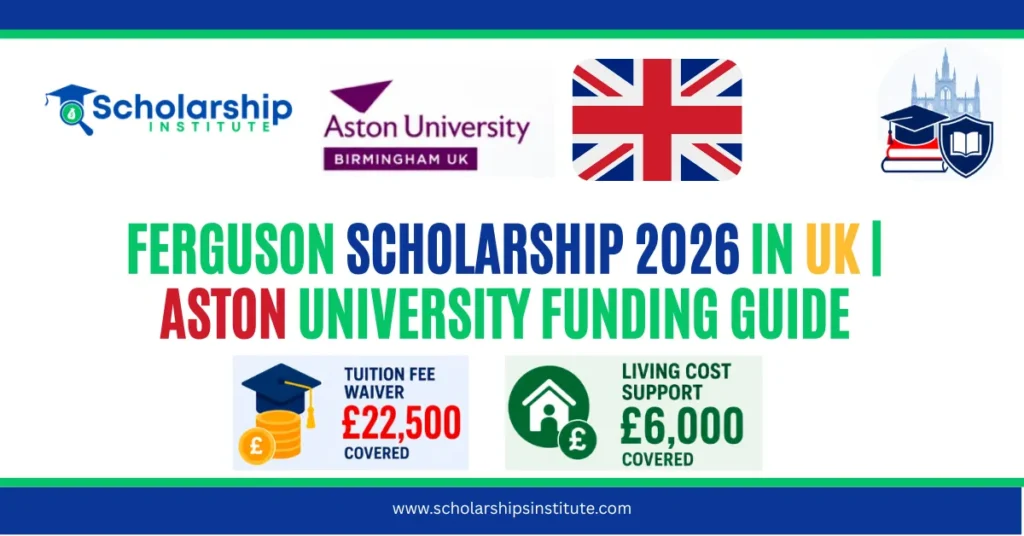
| Tuition fee cover | £22,500 | Aston says this is the tuition support amount on the official page. |
| Living-cost contribution | £6,000 | This is a contribution, not a promise to fund every expense. |
| Total scholarship value | £28,500 | At a mid-market rate of 1 GBP = 1.3414 USD, that is about $38,229.90 total. |
| Flights, visa, insurance | Not listed | The official page does not mention these items, so do not budget as if they are included. |
A small but important nuance: directory sites often call this scholarship “fully funded,” but Aston’s own wording is more precise. It covers tuition and gives a living-cost contribution; the page does not promise every study expense.
Who is eligible?
Use this as a quick pass/fail check before you spend time on the form.
| Requirement | Official detail | Pass / fail indicator |
|---|---|---|
| Nationality | Must be from India or an African country | Pass only if you fit this rule. |
| Course offer | Must hold a conditional or unconditional offer for one of the eligible programmes | No offer, no application. |
| Degree result | Must hold a 2:1 degree or equivalent in a relevant subject | Your earlier degree matters a lot. |
| Funding status | Must be self-funded | If you already have external sponsorship, you do not qualify. |
| Agency referrals | Not allowed | Aston says agency-referred candidates are not eligible. |
| Course fit | One of the ten listed postgraduate taught programmes | Only the official list counts. |
One common misconception deserves a clear answer. This scholarship is not open to every international student from a developing country. For example, Pakistan, Bangladesh, Indonesia, the Philippines, Saudi Arabia, and the UAE do not meet the nationality rule on the official page, even if the applicants are strong.
Required documents
Aston does not publish a long scholarship document checklist on the official page, and that matters. The page does make three things clear: you must first apply for the course, you must have the 9-digit application number, and you must complete the scholarship webform before the deadline.
| Item | Officially stated? | Practical tip |
|---|---|---|
| Course application | Yes | Apply for the master’s course first, or the scholarship form will not make sense. |
| 9-digit application number | Yes | Save it as soon as you get it. You will need it for the scholarship form. |
| Conditional/unconditional offer | Yes | Keep the offer letter ready because eligibility depends on it. |
| Scholarship form answers | Yes | Write them like short mini-essays, not one-line answers. |
| Evidence for UKVI living costs | Yes, if successful | Aston says successful students must show they can fully contribute to living costs for UKVI. |
| Transcript / CV / passport | Not listed on scholarship page | Keep them ready anyway for admission and visa work, but do not treat them as the official scholarship checklist. |
How to apply for Ferguson Scholarship 2026 in UK step by step
- Pick one eligible Aston programme from the official list before you do anything else. Aston only accepts applications for the listed postgraduate taught courses.
- Apply for admission through the course page and wait for your 9-digit application number. Aston specifically tells applicants to use that number in the scholarship form.
- Check nationality, funding status, and degree classification again. This award is strict, and one wrong assumption can waste your time.
- Open the scholarship webform on Aston’s Ferguson page. That is the official application portal for this award.
- Fill in the exact programme name you applied for. Do not guess or abbreviate the course title if your application uses a different name.
- Answer the three personal questions carefully. Aston asks for a brief description of yourself, your reasons for needing the scholarship, and your career aspirations, each with a 300-word limit.
- Submit before 29 May 2026. Aston says the awards will be announced by email in June 2026, so check the inbox you used in the application.
The best applications do not sound rushed. They sound intentional, specific, and tied to one clear academic path. That is the difference between a form that gets glanced at and a form that feels ready to shortlist.

How to write a winning SOP for Ferguson Scholarship
Your SOP should do three jobs at once: prove academic fit, show financial need without sounding dramatic, and explain how your degree will help you solve a real problem after graduation. The committee does not need a life story. It needs a focused plan.
Structure that works
Use this order: problem, preparation, fit, future impact. Start with the issue you want to solve, then show why your background makes you a credible candidate, then connect that to the Aston programme, and finally explain the change you plan to drive. That structure fits the scholarship’s own focus on merit, course fit, and development impact.
Opening sentence example
You can open like this: “I want to use MSc Biotechnology at Aston to build low-cost diagnostic capacity for communities that still face delayed disease detection.” That opening works because it names the course, the problem, and the outcome in one sentence.
What to avoid
Do not start with “I have always wanted to study in the UK.” That line says almost nothing. Also avoid vague claims like “I am hardworking” or “Aston is a great university” unless you tie them to a specific programme feature or career result.
Word count guidance
Aston’s form asks for three responses of up to 300 words each, so keep every answer tight. If you are writing a separate SOP for your course application, keep that version around 500–700 words unless the department asks for something different.
What the committee likely prioritizes
Aston does not publish a scoring rubric, but the form gives you the clues. It asks for your background, your reason for needing support, and your career aims, so the committee is clearly looking for merit, financial need, and a believable plan to use the degree well. That is an inference, but it fits the official form design very closely.
Selection criteria — what they really look for
The official page does not spell out a scoring sheet, so students should read the eligibility rules as a hidden roadmap. The strongest candidates usually have a relevant academic record, a clean fit with one of Aston’s listed programmes, and a career plan that feels realistic for their home country.
Here is the part many applicants miss: Aston is not just looking for a student who can study well. It is looking for a student who can use the degree after graduation and explain that path clearly in writing. That is why the three short answers matter so much.
Common mistakes that sink strong applicants
The biggest mistake is applying for the scholarship before you secure the course offer. Aston makes the order very clear: course application first, scholarship form second. If you reverse that order, you lose time and often lose the deadline.
Another common mistake is ignoring the self-funded rule. Students sometimes assume that a partial sponsor or education loan counts the same way, but Aston says external sponsorship makes you ineligible. A third mistake is using an agency-referred application, which the university rejects.
Similar UK scholarships to compare
If you want a wider UK funding search, these ScholarshipsInstitute pages are worth opening next:
- Chevening Scholarship 2027 – Fully Funded | Apply Now. This is the best comparison if you want a UK government-funded master’s route with leadership value.
- Developing Solutions Masters Scholarship 2026 in UK. This fits students who want to tie a master’s degree to development impact in their home country.
- University of Bath Think Ambitious Scholarships 2026 in UK. This is useful if you are comparing other UK master’s scholarships at a top university.
FAQ
Is Ferguson Scholarship 2026 in UK fully funded?
Yes, but only in the scholarship-specific sense that Aston uses on its page. The official award covers full tuition plus a living-cost contribution, and it does not list flights, insurance, or visa costs.
Who can apply for it?
Only students from India or an African country can apply in this cycle. You also need a conditional or unconditional offer for one of Aston’s eligible postgraduate taught programmes.
Do I need an offer before I apply?
Yes. Aston says you must first apply for the course and hold a conditional or unconditional offer before you complete the scholarship form. Without that offer, you do not meet the eligibility rule.
How many awards are available?
Three awards are available for the 2026/27 academic year. That low number makes this scholarship highly competitive.
Can Pakistani students apply?
No. The official nationality rule limits the award to India and African countries, so Pakistani applicants do not qualify for this cycle.
What should I focus on in the scholarship answers?
Focus on your course fit, your financial need, and your career plan. Aston’s form asks exactly for those themes, so a vague answer will not help you.
The Ferguson Scholarship 2026 in UK rewards students who move fast, match the eligible course list, and write answers that sound specific to Aston. If you secure the course offer first and keep your application focused, you give yourself a real chance at one of the three awards.